Similar to Design Thinking models, CX Management can be described in different ways that many smart people are working on. A lot of them can be found in Jonas Kronlund‘s LinkedIn group for Business Designers.
While I certainly don’t consider myself any smarter than these folks, I documented my own approach, which combines some standard tools with my own personal flavour to create something I feel works very well to feed an innovation portfolio.

The programmatic steps are as follows.
STEP ONE: Always start with documenting, updating or articulating the organization’s vision. There are thousands of papers on this topic, but I like hacking the famous “How Might We” of design to create a useful vision statement:
“How might we [do something] so that [intended outcome] resulting in [measurable success].”
Take away the “How might” and you have a vision statement you can turn around as desired.
Example for a taxi app might be: “How might we use mobile and social technology to connect drivers and passengers, so that people can find rides more conveniently and efficiently, resulting in better, cheaper, more ecological mobility.”
This exercise should be the pillar for designing the management team’s strategy.
STEP TWO: Mapping out the strategy is also a much maligned exercise for managers running from one meeting to another, but it’s a critical one. Again, I don’t need to summarize or replicate the millions of words already written on the topic of strategy. To be concrete, I recommend using Strategyzer’s business model canvas. This allows leadership teams to refer back to a visual map of their business and think holistically about what they are trying to accomplish, for whom, and through which channels.
These first two steps are foundational and should be carried out in a focused, executive offsite. If possible, the sessions should be moderated by an external party to ensure optimal, objective participation.
STEP THREE: Once the foundations are in place, the CX leader needs to drive a workstream to create what I call a CX business blueprint.
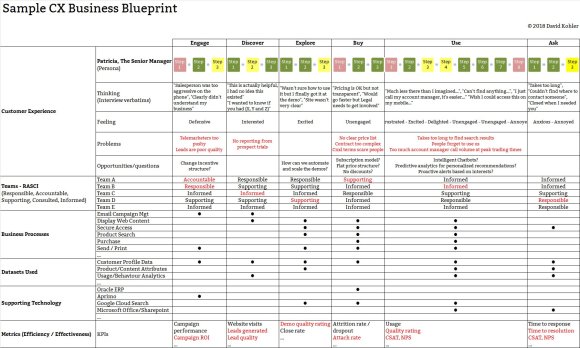
This map gives management teams immediate, visual information on opportunities and pain points, but also an operational map and KPIs to drive change and track progress. Those familiar with Gartner’s classic 8 Building Blocks of CRM will recognize the elements here.
The CX business blueprint goes farther than a traditional Service Design Blueprint or customer experience map, and serves as the centre piece of the overall process. Click here for a deep-dive into its components and how to build it.
STEP FOUR: Once the team have a concise view of the opportunities and shortfalls, they need to build a portfolio of innovation projects with a tightly-defined scope and expected outcomes. At this point teams will be using design thinking to drill down from the end-to-end customer experience map to the specific journey relating to the problem. If you’re not sure what the difference is between experience maps and customer journey maps, this article explains it quite well.
I encourage project teams to use design thinking approaches to research user needs and behaviour, generate ideas, build prototypes and test them out. Ideo provides a great foundation for this, as does Stanford University’s famed d.school, but I tend to follow the UK Design Council’s Double Diamond, which is developed even further here by Dan Nessler.
STEP FIVE: At this phase, we are following classic innovation management practices, where the team acts as an “innovation lab” or “idea factory” with the remit of launching and managing multiple pilot programs at once.
Optimally, the team launches either small-scale pilots (test group, small geography, etc.) or large-scale pilots where there is good upside and little downside (an obvious gap, a dead zone in the business, or a completely broken service).
Lean startup principles apply here: failure is considered a learning input. Pilots that succeed are scaled out and up; those that fail to convince are either improved or stopped.
The critical discipline is to continue to update and work from the CX Business Blueprint. Learnings from pilot programs will drive new insights into customer needs, opportunities and pain points, which may in turn drive new metrics and problems to solve.
Furthermore, no organization is perfect and no business is static; customer expectations will evolve over time. Organizations must always continue to not only incrementally improve, but also innovate and delight in new ways.
If you have any questions or comments, please feel free to reach out to me on david.p.kohler(&)gmail.com.
 David.p.Kohler